
Betül Kaçar - Astrobiology Research: Exploring Fundamental Questions of Life on Earth and Beyond
Program Date: April 14, 2027
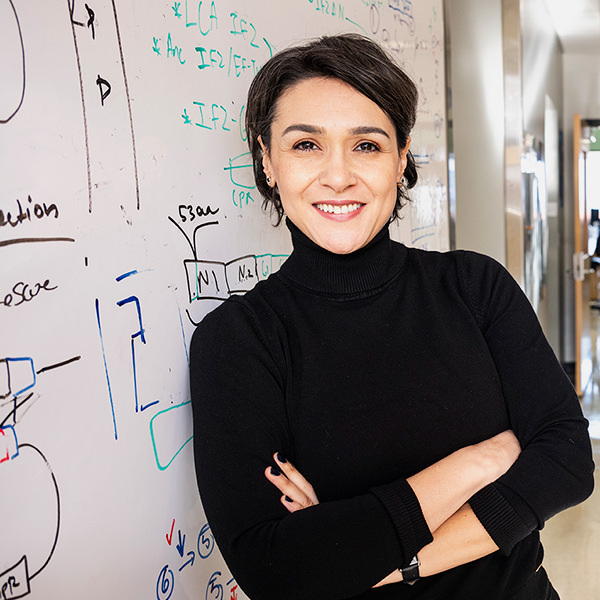
Dr. Betül Kaçar is a professor in the College of Agricultural and Life Sciences Department of Bacteriology at the University of Wisconsin-Madison, where she leads a NASA-funded astrobiology research center and her own molecular paleobiology laboratory. Across research endeavors, Kaçar explores fundamental questions about how life originated and evolved on Earth and how we find life beyond our solar system. She partnered with UN Women to expand representation in STEM globally. Asteroid 284919 Kaçar, discovered by astronomers using the NASA WISE space telescope, was named in her honor.
Kaçar’s research encompasses the origins of life, early evolution, life in the universe and how the molecular mechanisms of evolution can be understood. She currently leads a NASA Astrobiology Center in molecular paleobiology to understand alien planets and ancient life.[11] She is the first Turkish woman and the youngest scientist to lead a NASA research center. She was the first to resurrect an ancient gene inside a modern microbial genome. She coined the term paleo phenotype, reconstructing and examining the evolutionary history of contemporary components and then tying their phenotypes into biosignatures to provide insight into innovations that are grounded in the rock record and thus in the geological and ecological context. In 2020, she proposed a possible application of prebiotic chemistry, protospermia, sending the chemical capacity for life to emerge on another planetary body. Her research team defined "evolutionary stalling" as an evolutionary mechanism to prevent a module from reaching its local performance peak and thereby imposes a genetic load, i.e., the organism carrying a stalled module suffers a fitness cost relative to an organism whose module performance is optimal.
Kaçar was born in Istanbul. She was the first woman in her family to receive formal education. She studied chemistry at Marmara University. She received a Howard Hughes Medical Institute undergraduate fellowship to spend a summer conducting scientific research using organic chemistry at Emory University. She returned to Emory University, and eventually earned a PhD in Biomolecular Chemistry in enzyme structure-function relationship. Kaçar transitioned to study origins of life after Ph.D. She was appointed as a NASA postdoctoral fellow at Georgia Institute of Technology. She was awarded a NASA scholarship in 2011, followed by funding from the NASA Astrobiology Institute and Exobiology Branch in 2013. She joined Harvard University in 2014, where she led an independent research group as a fellow in the Department of Organismic and Evolutionary Biology. In 2015, she received the Templeton Fellowship and became a member of the Harvard Origins Initiative. Kaçar was named NASA Early Career Faculty Fellow in 2019. In 2020, she received the Scialog fellowship for her studies on life in the universe by the Research Corporation and Science Advancement. She has served on the National Academies' "A Science Strategy for the Human Exploration of Mars" panel. In this role, she contributed to determining NASA's science objectives and priorities for Mars exploration. In 2025 she received the Keck Foundation Award to study evolution of ancient metabolisms.]